
Carpet Tiles vs Broadloom Carpet: How B2B Buyers Should Choose for Offices, Hotels and Corridors
A procurement guide for facility managers, contractors and hotel buyers comparing modular carpet tiles with wall-to-wall broadloom by maintenance, replacement, comfort, design and quotation risk.

Pain Point Addressed
Many commercial flooring projects compare carpet tiles and broadloom only by square metre price, then discover later that repair method, pattern continuity, installation shutdown and spare stock matter just as much.
Answer First: Choose by Replacement Risk, Not Only by Appearance
For most office projects, carpet tiles are usually easier to maintain because damaged or stained areas can be replaced locally. For hotels, casinos and branded public interiors, broadloom carpet can still be the better choice when the buyer needs stronger design continuity, fewer visible seams and a more immersive wall-to-wall look.
| Decision point | Carpet tiles | Broadloom carpet |
|---|---|---|
| Local replacement | Strong fit when individual tiles may need future replacement | Possible, but repairs usually need roll planning and skilled seaming |
| Office chair traffic | Often preferred for open offices and phased renovations | Can work, but replacement is less modular |
| Hotel corridor look | Useful where maintenance and access are priorities | Often preferred for continuous corridor pattern and hospitality feel |
| Installation disruption | Can support phased work in occupied offices | May require larger cleared areas and roll handling |
| Design continuity | Tile direction and batch matching must be controlled | Better for large-flowing patterns and wall-to-wall visual continuity |
| Spare stock plan | Keep matching spare tiles for high-risk zones | Keep spare roll material and confirm dye-lot control |
When Carpet Tiles Are the Safer Commercial Choice
Carpet tiles are usually the safer choice when the project needs modular replacement, phased installation or future tenant changes. This is why office fit-outs, coworking spaces, corridors in commercial buildings and rental workspaces often start with commercial carpet tiles instead of broadloom.
- Occupied office renovation. If the buyer cannot shut down the full floor, carpet tiles make it easier to divide work by zones, teams or weekends.
- Rolling-chair and traffic lanes. High-use chair areas can be planned with suitable construction, backing stability and spare tiles for later replacement.
- Future layout changes. Commercial tenants may move desks, partitions and equipment. A modular floor is easier to adapt than a continuous roll installation.
- Budget control over time. The first square metre price is not the only cost. Replacement speed, spare stock and downtime can change the total project cost.
When Broadloom Carpet Is the Better Specification
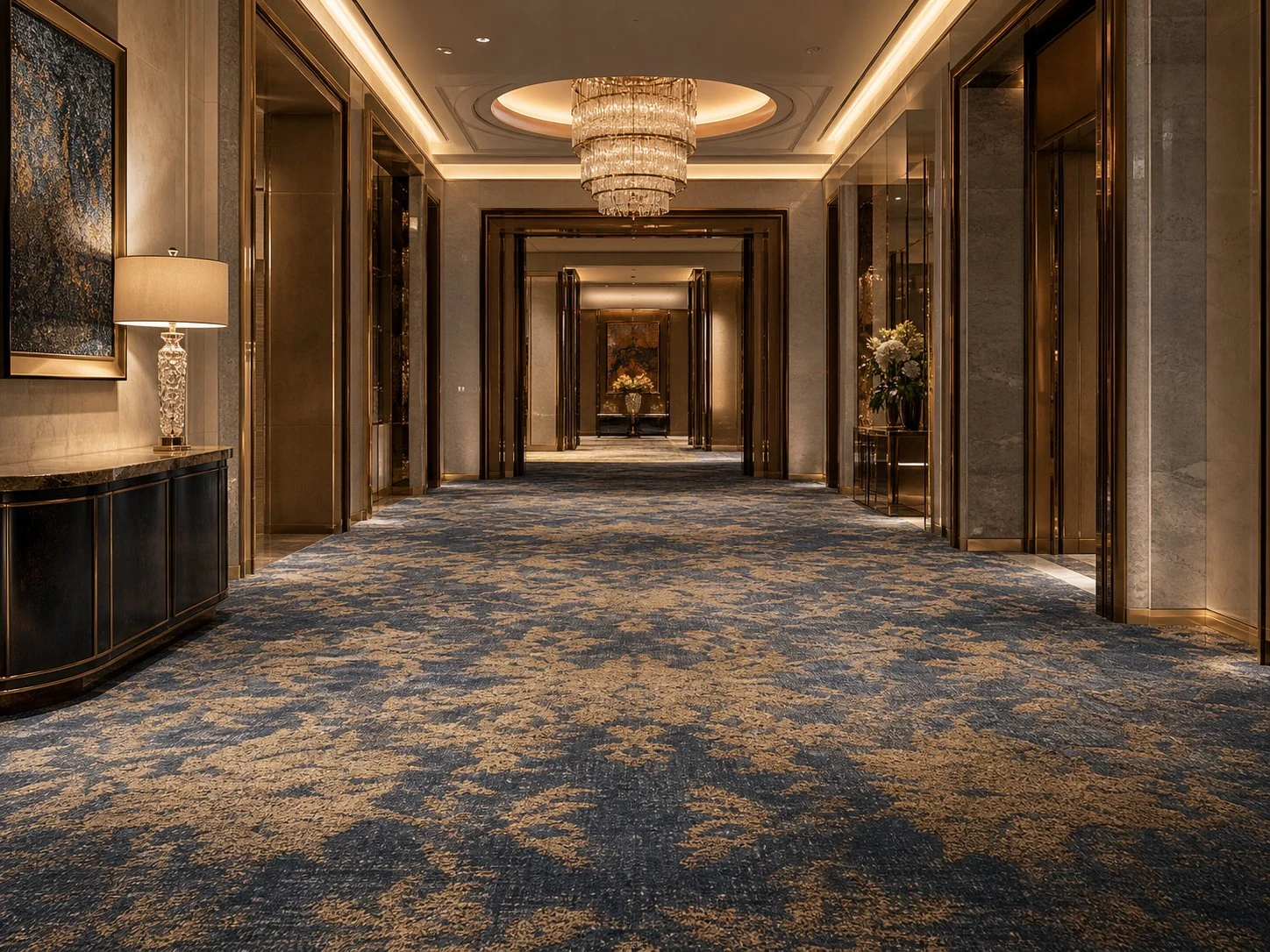
Broadloom carpet is often stronger when a hotel, casino, ballroom or guestroom needs a continuous hospitality atmosphere. A roll format can support larger-scale patterns, fewer tile joints and a softer wall-to-wall impression, especially in corridors and branded guest areas.
- Hotel corridors and guestrooms. Broadloom can help create a continuous hospitality look while supporting acoustic comfort and a softer guest experience.
- Large custom patterns. When the design depends on flowing motifs or custom printed visual effects, broadloom may carry the pattern more naturally than small modules.
- Public hospitality areas. In casinos, banquet halls and formal hospitality spaces, buyers may value visual continuity more than tile-by-tile replacement.
- Coordinated project supply. Roll width, roll length, seaming plan, cutting waste and spare material should be confirmed before quotation.
RFQ Checklist Before Comparing Prices
Buyers often ask for a carpet tile or broadloom price too early. A useful RFQ should describe how the floor will be used, where replacement risk is highest and which documents are needed for approval. Without that scope, quotations can look comparable while representing different materials, backing systems, packing units or installation assumptions.
| RFQ item | Why it matters | What to send |
|---|---|---|
| Application zone | Office, hotel corridor and ballroom traffic are not the same | Floor plan, room type or area schedule |
| Format preference | Tile and broadloom pricing depends on different units and waste factors | Preferred format or request both options |
| Material expectation | Fiber and backing affect durability, feel and budget | Target construction or current reference sample |
| Replacement strategy | Spare stock planning affects future maintenance | High-risk zones and expected spare percentage |
| Timeline | Production and shipping need written confirmation | Target sample date, order date and installation date |
| Documents | Technical data varies by product construction | Required TDS, test information, packing data or tender forms |
Final MOQ, lead time, availability, test documents and quotation validity must be confirmed in writing for the selected construction and order quantity.
Buyer FAQ: Carpet Tiles vs Broadloom
| Question | Short answer |
|---|---|
| Are carpet tiles always cheaper than broadloom? | Not always. The real comparison should include product specification, backing, waste, installation, spare stock and future replacement cost. |
| Which is better for offices? | Carpet tiles are often better for offices because they support phased work, local replacement and layout changes. |
| Which is better for hotel corridors? | Broadloom is often preferred for continuous corridor design, but carpet tiles can be useful where maintenance access and replacement speed are more important. |
| Can one project use both formats? | Yes. Many commercial projects use carpet tiles in work areas and broadloom in hospitality or branded guest areas. |
| What should I ask the supplier first? | Ask for format recommendation, suitable construction, MOQ, sample process, packing unit, spare material plan and written quotation validity. |
Final Recommendation for B2B Buyers
Choose carpet tiles when maintenance flexibility, phased replacement and office traffic control are the main risks. Choose broadloom carpet when design continuity, acoustic comfort and hospitality atmosphere are more important. For mixed-use commercial buildings, the best answer may be both: modular carpet tiles for office zones and wall-to-wall broadloom for hotel or public hospitality zones.
VISHOME can help buyers compare carpet tile and broadloom options for offices, hotels, corridors and public-area projects. Send the application zone, quantity, target market, preferred design, timeline and required documents through the project quote form so the team can recommend a suitable format and quotation basis.
Turn This Guide Into a Quote
Send Your Project Requirements After Reading This Guide
If this topic matches your project, send the carpet application, estimated area, destination, and required date. Vishome can recommend the related product path and reply with sample, MOQ, lead time, and quotation details.
Email: sales@vishomecarpet.com
Continue Your Specification
Related Products



Browse the Full Range
Related Product Categories
Product Category
Commercial Carpet Tiles
Modular commercial carpet tiles for offices, hotels, corridors, education, and phased replacement programs.
View Category →
Product Category
Wall-to-Wall Carpets
Custom broadloom carpet for guestrooms, corridors, lobbies, ballrooms, and branded hospitality interiors.
View Category →