
How Commercial Carpet Tiles Can Reduce Maintenance Disruption and Lifecycle Costs
Strategic flooring solutions for hotels, offices, and retail environments.
Pain Point Addressed
High maintenance budgets, frequent replacement needs, and downtime costs.
Direct Answer: Where Carpet Tiles Create Lifecycle Value
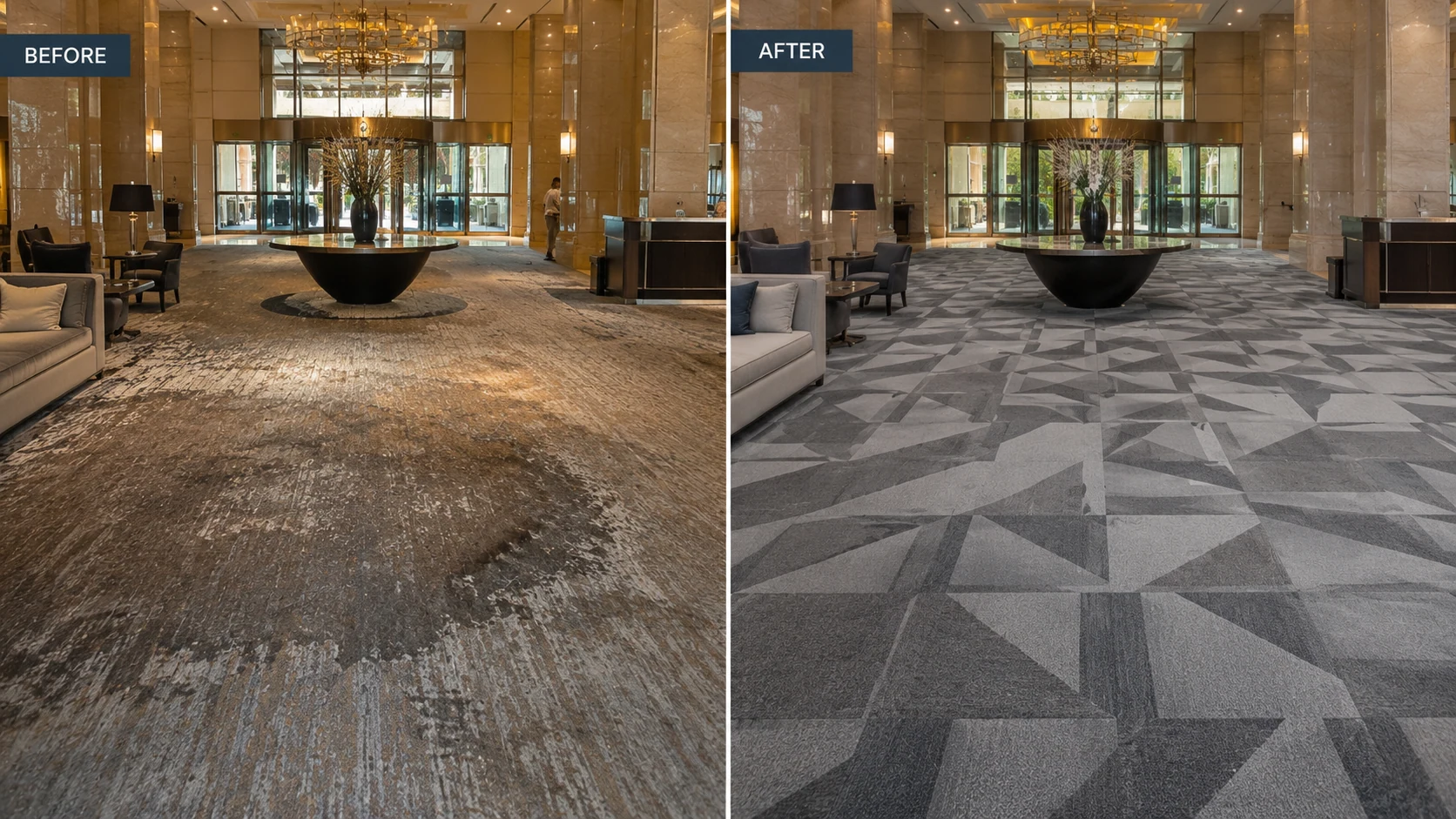
Commercial carpet tiles can reduce maintenance disruption when damage and wear are localized, the site retains spare tiles from the approved batch, and the installation system allows individual modules to be lifted and replaced. The saving does not come from the tile format alone. It comes from a maintenance plan that limits replacement to the affected zone instead of automatically removing a complete floor area.
| Decision factor | Broadloom planning question | Carpet tile planning question |
|---|---|---|
| Localized damage | Can the damaged section be repaired without a visible seam? | Are matching spare tiles available from the same approved batch? |
| Operational access | How long must the full work zone be closed? | Can replacement be phased by room, bay, or traffic lane? |
| Subfloor access | Will large rolls restrict access to services? | Does the modular system support access-floor maintenance? |
| Appearance control | Can replacement material match the aged field? | Was attic stock stored under suitable conditions? |
This comparison is a procurement framework, not a universal cost guarantee. Labor rates, site access, adhesive, pattern direction, and retained stock determine the actual result.
Installation and Maintenance Conditions That Matter
- Subfloor Record moisture, flatness, cleanliness, access-floor joints, and any preparation needed before installation.
- Installation system Confirm the releasable adhesive or approved tab system, application rate, open time, and compatibility with the selected backing.
- Layout Document monolithic, quarter-turn, ashlar, or brick direction so replacement tiles follow the approved visual pattern.
- Attic stock Reserve labelled spare tiles from the approved batch and store them flat, dry, and traceable to the installation zone.
- Cleaning plan Match vacuuming, spot treatment, extraction, and drying procedures to the fiber, backing, soil load, and operating hours.
A modular format can support phased renovation and service-floor access, but poor subfloor preparation or an incompatible adhesive can erase that advantage. Procurement should therefore compare the complete flooring system, not only the tile price.
Build a Lifecycle Cost Comparison Before Awarding the Order
A useful commercial carpet tile cost model separates known inputs from assumptions. Record material, freight, subfloor preparation, installation, planned spare stock, routine cleaning, periodic extraction, local repair labor, disposal, and operating downtime. Then compare the same service period and traffic conditions across every option.
| Cost input | What the buyer should request | Why it changes the decision |
|---|---|---|
| Initial supply | Quoted construction, unit, quantity, packing, Incoterm, and waste allowance | Prevents unlike products from being compared as if they were identical |
| Replacement scope | Expected repair unit and retained-spares plan | Shows whether a local defect triggers a tile, zone, or full-area replacement |
| Maintenance | Approved cleaning method and frequency | Reveals labor, equipment, chemistry, drying, and access requirements |
| Downtime | Hours and areas unavailable during installation or repair | Captures operational cost that is absent from the material quote |
Procurement checklist
- Define the room type, traffic, rolling-chair use, cleaning schedule, subfloor, and local fire requirements.
- Compare fiber, pile construction, backing, total thickness, dimensional stability, and the documents supplied with the quote.
- Approve a physical sample and record the product, color, batch, layout direction, adhesive, and spare-tile quantity.
- Request pricing for supply, installation inputs, freight, and retained stock on the same commercial basis.
- Send the project area and requirements through the quotation form before treating any published range as a final price.
Frequently Asked Buyer Questions
How many spare carpet tiles should a project keep?
There is no universal percentage. The correct quantity depends on total area, number of colors, pattern direction, expected damage, future availability, and the number of operating zones. Ask the supplier and installer to agree a labelled attic-stock plan before shipment.
Are carpet tiles always cheaper than broadloom?
No. Material price, backing, subfloor preparation, installation method, waste, and local labor can make either format more economical. Carpet tiles become especially relevant when selective replacement, phased work, or access-floor flexibility has measurable value.
Can any damaged tile be replaced with a new one later?
A technically compatible replacement may still look different because of batch variation, wear, cleaning history, and direction. Retaining approved spare tiles and recording the layout reduces this risk.
What should be included in a factory quotation?
Provide project area, application, traffic, fiber preference, backing, subfloor, tile size, color, quantity, destination, delivery date, testing requirements, and Incoterm. The final quotation should identify the exact construction and order terms.
Turn This Guide Into a Quote
Send Your Project Requirements After Reading This Guide
If this topic matches your project, send the carpet application, estimated area, destination, and required date. Vishome can recommend the related product path and reply with sample, MOQ, lead time, and quotation details.
Email: sales@vishomecarpet.com
Continue Your Specification
Related Products


Browse the Full Range