
Commercial Carpet Tile MOQ: How to Plan Samples, Trial Orders, and Project Quantities
A practical framework for moving from material samples to trial areas and full project quantities without creating avoidable inventory or quality risk.
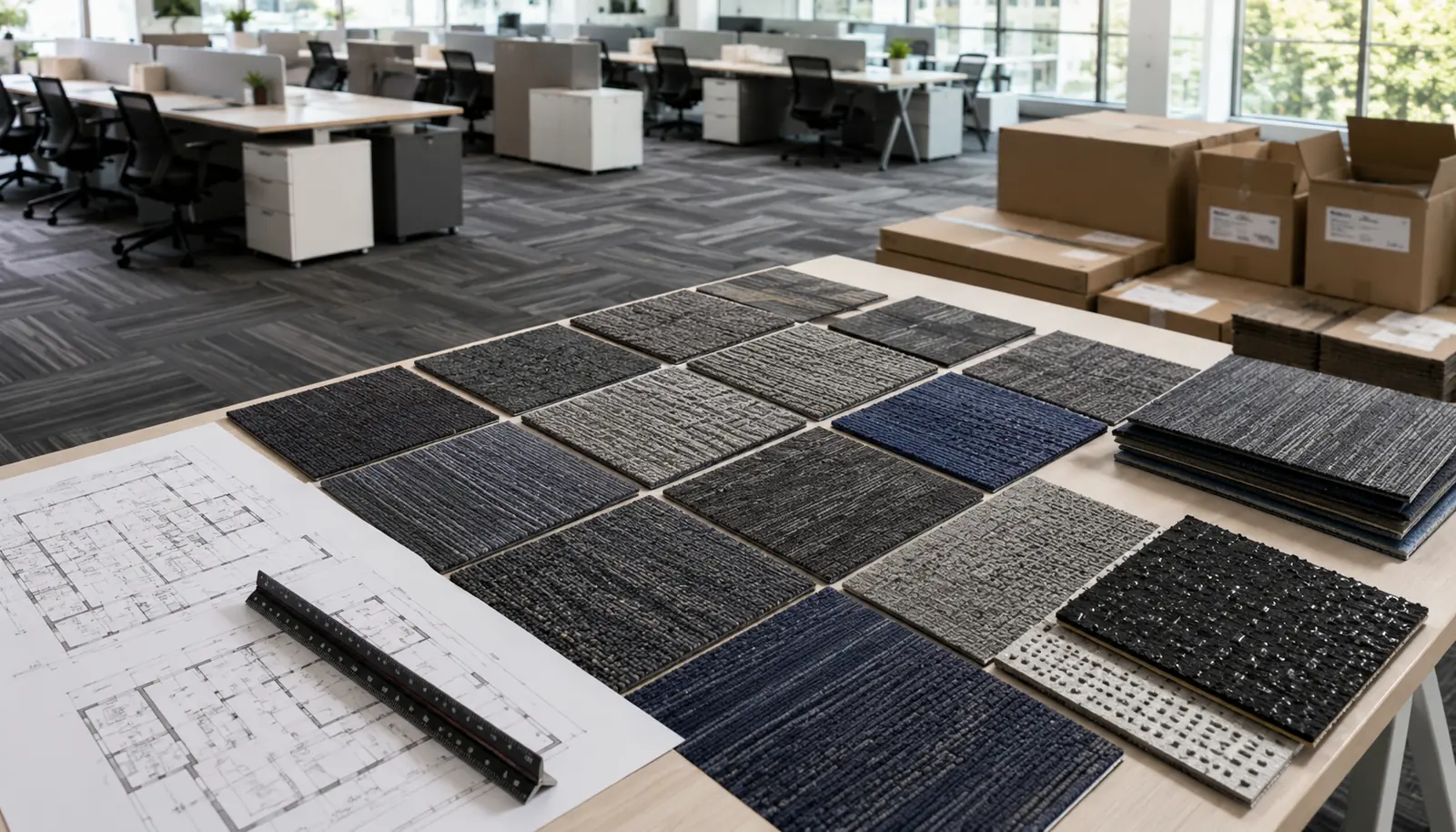
Pain Point Addressed
A single minimum-order number can hide different requirements for standard colors, custom constructions, accent quantities, spare stock, packaging, and phased delivery.
The Short Answer
For a commercial flooring buyer, the minimum order is not just a number on a quotation. A practical commercial carpet tile MOQ should support three decisions: whether the material is suitable, whether the selected construction can be tested in a real space, and whether the factory can produce the full project consistently.
Do not evaluate a supplier using only the lowest advertised quantity. Ask for three clearly separated order levels: a sample for material screening, a trial order for real-world validation, and a project order tied to one approved specification, colorway, backing, packing method, and delivery plan.
- Sample. A material swatch or tile for checking color, texture, pile construction, backing, dimensions, and compatibility with the specification.
- Trial order. A limited quantity for a mock-up room, test zone, dealer display, pilot office, or installer evaluation.
- Project order. The full quantity produced against the approved product, color, quality controls, packing instructions, and delivery schedule.
Why One MOQ Number Can Be Misleading
A supplier may offer a low quantity for an existing color but require a higher quantity for custom yarn, custom backing, special packaging, or an exclusive pattern. Another supplier may accept a small order but combine it with unrelated production, which can affect the production date or color consistency.
The right commercial carpet tile MOQ therefore depends on what the buyer is asking the factory to change. Standard stock, standard production, and custom development should not be treated as the same order.
- Confirm whether the stated quantity applies to one color or several colors combined.
- Ask whether one order may include multiple backing systems or constructions.
- Separate stock material from made-to-order production.
- State whether standard cartons or private-label packaging are required.
- Confirm whether the quantity applies to one shipment or split deliveries.
- Ask whether the product is repeatable or tied to one production batch.
If these conditions are unclear, two suppliers can appear to offer the same minimum while quoting very different commitments.
A Three-Level Ordering Framework
| Order level | Main purpose | What to verify | Decision |
|---|---|---|---|
| Material sample | Initial product screening | Surface color, texture, pile, backing, dimensions and available documents | Decide whether the product deserves further evaluation |
| Trial order | Real-world validation | Installation behavior, seam appearance, chair traffic, cleaning and adhesive compatibility | Approve, revise or reject the specification |
| Project order | Full project supply | Approved sample, batch consistency, packing, quantity, lead time and inspection | Release production against a controlled specification |
The exact quantities depend on whether the product is standard, made to order, or customized by color, backing, packaging, or design.
Stage 1: Use the Sample to Eliminate the Wrong Products
A sample is valuable when it answers specific questions. Looking at a small square only to decide whether the color is attractive is not enough for a commercial project.
Ask the supplier to identify the sample with the product and color codes, fiber type, pile construction, pile weight, tile size, total thickness, backing, intended traffic condition, available test documents, and sample reference.
- Traceability. The physical sample should match a written data sheet and a product reference that can be used again during approval.
- Construction. Check whether the fiber, pile, backing, thickness, and tile dimensions match the proposed quotation.
- Documentation. Confirm which fire, static, acoustic, environmental, or other reports apply to the exact construction being considered.
If the backing, thickness, color reference, or construction cannot be traced, it will be difficult to use that sample as an approval standard later.
Stage 2: Know When a Trial Order Is Worth the Cost
A trial order is especially useful when the flooring will be installed in a large occupied building, rolled over by office chairs, exposed to entrance soil, laid on raised access floors, or maintained by a local cleaning contractor.
Use the trial quantity to build a realistic area rather than scattering individual tiles. A small meeting room, workstation bay, corridor junction, lift lobby, or dealer showroom can reveal issues that a loose sample cannot show.
- Check whether tile edges remain visually controlled across a larger field.
- Compare monolithic, directional, quarter-turn, or other approved installation layouts.
- Confirm that the backing lies flat after the required acclimation period.
- Verify that the approved adhesive suits the actual subfloor.
- Test the local cleaning method on the installed product.
- Compare replacement tiles with the installed field before approving spare-stock rules.
The purpose is not to simulate ten years of use in a few days. It is to identify obvious specification, installation, or operational problems before the full quantity is released.
Stage 3: Calculate the Project Quantity Correctly
The floor-plan area is only the starting point. A project order should also account for installation layout, cuts, damaged material, attic stock, phased handover, and future replacement.
The allowance should be decided with the installer. A simple rectangular office installed in a straight layout may need less additional material than a floor with diagonal installation, curved partitions, numerous small rooms, or multiple color transitions.
Spare stock serves a different purpose from installation allowance. It remains with the building operator for future localized replacement. Carpet tiles make spot replacement practical, but only when compatible replacement material is available.
When reviewing a commercial carpet tile MOQ, ask whether the final project quantity can include labeled spare cartons from the same production batch. A small replacement batch ordered years later may be technically compatible but still show a visual difference because of batch variation and wear on the existing floor.
Multi-Color Designs Need Their Own Quantity Check
A floor pattern may use three colors, but the factory may apply a minimum to each color rather than to the combined project area. This matters when an accent color represents only a small percentage of the floor.
| Color role | Planned area | Waste allowance | Spare quantity | Total required |
|---|---|---|---|---|
| Main field color | ___ sqm | ___ sqm | ___ sqm | ___ sqm |
| Secondary color | ___ sqm | ___ sqm | ___ sqm | ___ sqm |
| Accent color | ___ sqm | ___ sqm | ___ sqm | ___ sqm |
The supplier can then confirm whether each color is available as standard production, whether quantities can be combined, and whether an accent should be redesigned using a stocked color. This discussion should happen before design approval because changing the ratio later can affect cost, lead time, and carton allocation.
The Lowest MOQ Is Not Always the Lowest-Risk Choice
A small quantity can be useful for a pilot area, but it may not be the best basis for a large project when production control, documentation, and repeatability matter more than obtaining the smallest possible commercial carpet tile MOQ.
- The project needs a custom color that has not been approved in a full production trial.
- The order will be delivered in several phases or across several buildings.
- The client needs repeatability for a wider property program.
- The installation date leaves no recovery time for an unsuccessful batch.
- Local regulations require documents tied to the supplied construction.
- The project needs special carton labels, pallet plans, or room-by-room allocation.
What to Include in a Carpet Tile RFQ
A complete RFQ helps the supplier recommend the correct sample, trial quantity, and production plan. If the specification is still open, send the operational requirements instead of inventing technical values.
- Project country, city, building type, and planned installation date.
- Installation area by floor, room, or use zone.
- Required tile size and preferred installation direction.
- Fiber, pile construction, backing, and thickness requirements.
- Traffic conditions, including rolling chairs and entrance zones.
- Fire, static, acoustic, environmental, or local compliance requirements.
- Number of colors and approximate quantity per color.
- Destination port or delivery address and target arrival date.
- Packaging, pallet, labeling, and private-label requirements.
- Required sample, trial area, inspection plan, and spare stock.
Questions to Ask Before Approving the Order
Use these questions to turn the commercial carpet tile MOQ into a controlled purchasing decision rather than an isolated number in a sales conversation.
- Is the sample taken from stock, a production batch, or a development sample?
- Does the trial quantity use the same construction planned for the project?
- Is the minimum calculated per design, per color, per backing, or per shipment?
- Can standard colors be combined in one trial order?
- Will all project cartons come from one controlled production batch?
- How are color, dimensions, edge condition, backing, and carton quantity inspected?
- Can spare stock be packed and labeled separately?
- Which test reports apply to the exact construction being supplied?
- What happens if pre-shipment inspection identifies a nonconformity?
The answers should appear in the quotation, specification sheet, approved sample record, or order confirmation. Important conditions should not remain only in a sales chat.
A Practical Buying Sequence
- Send the application, quantity, specification, destination, and schedule.
- Shortlist suitable constructions from the commercial carpet tile range.
- Request labeled material samples and relevant documentation.
- Approve a trial area when installation or operational risk justifies it.
- Confirm color quantities, allowance, spare stock, packing, and delivery phases.
- Sign or otherwise record the approved sample and reference standard.
- Release production and agree on inspection evidence before shipment.
This sequence does not make every project larger. It makes each ordering stage match a specific procurement decision.
Request a Project-Specific MOQ Plan
The appropriate commercial carpet tile MOQ depends on whether you need a standard color, a custom construction, several accent colors, special backing, private labeling, or phased delivery.
Send Vishome your floor area, application, specification, destination, and target date to receive a sample, trial-order, and project-quantity recommendation. The project team can also help compare nylon, polypropylene, PVC, bitumen, and PVC-free PE backing options for the intended space.
Continue Your Specification
Related Products
Browse the Full Range