
Hotel Carpet Renovation Guide: When Carpet Still Beats Hard Flooring in Guestrooms and Corridors
A procurement guide for hospitality teams in the United States, Canada and Australia comparing noise, comfort, maintenance, design and replacement risk.

Pain Point Addressed
Replacing worn hotel flooring is not only a visual decision: the wrong surface can increase corridor noise, reduce guest comfort and create avoidable maintenance or shutdown pressure.
Answer First: Start With the Hotel Zone, Not the Mood Board
For a hotel carpet renovation, carpet remains the safer choice when the project must control footstep noise, luggage-wheel sound, corridor echo, underfoot comfort and visible traffic wear. Hard flooring can be appropriate in moisture-prone or sand-heavy zones, but it should not replace carpet across guestrooms and corridors simply because it looks easier to clean in photographs.
| Decision point | Hotel carpet | Hard flooring |
|---|---|---|
| Footstep and impact noise | Naturally dampens sound; backing and underlay still need confirmation | Usually needs separate acoustic underlayment and detailing |
| Guest comfort | Warmer and softer underfoot | Clean visual impression but a harder, colder feel |
| Corridor luggage sound | Can reduce rolling and reverberant noise | Wheels and door activity can sound sharper |
| Selective replacement | Carpet tiles allow local replacement; broadloom needs roll planning | Planks or tiles may be replaceable, subject to batch matching |
| Typical fit | Guestrooms, corridors, meeting rooms and acoustic-sensitive floors | Bathrooms, entries exposed to moisture and selected extended-stay zones |
What to Check Before Approving a Hotel Carpet Renovation
- 1. Map each zone. Separate guestrooms, corridors, lift lobbies, stairs, meeting rooms, ballrooms and service areas. They do not have the same traffic, cleaning or design risk.
- 2. Review noise complaints. If guests already mention footsteps, luggage or upstairs impact noise, removing carpet without an acoustic plan can turn a visual upgrade into a review problem.
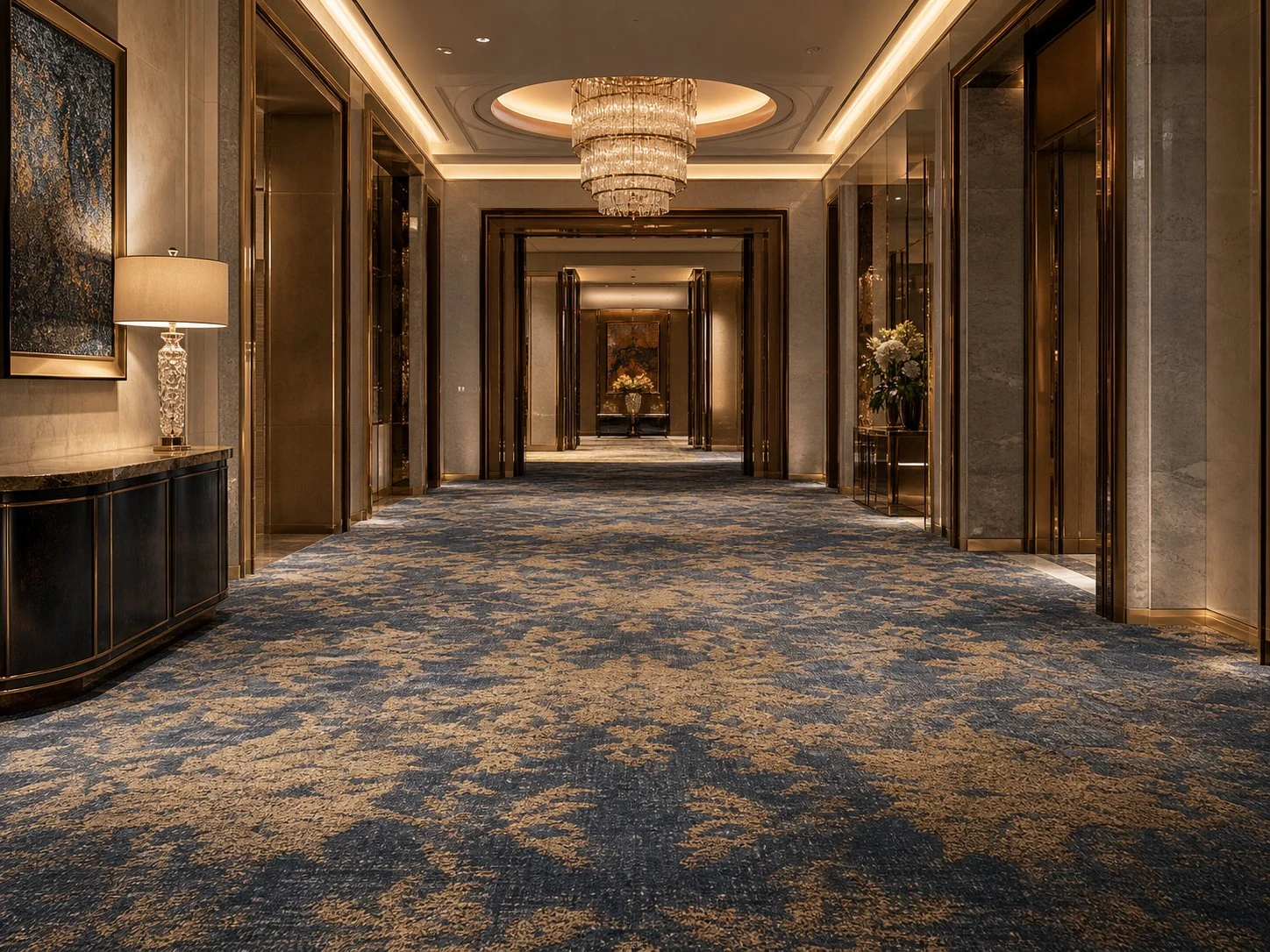
- 3. Treat pattern as a maintenance tool. Controlled contrast and mid-value color can keep trolley marks and traffic lanes less visually dominant between scheduled cleaning cycles.
- 4. Confirm the cleaning route. Ask who cleans the area, how often it is cleaned, what equipment is available and how quickly the zone must reopen.
- 5. Approve a physical sample. Record pile, backing, width, pattern repeat, direction and edge treatment after the team has reviewed a real strike-off or material sample.
Renovation Risks That Are Easy to Miss
- Replacing carpet only because it looks dirty. The underlying cleaning process, entrance soil control and traffic pattern may still need correction.
- Choosing a very light corridor design. A bright, low-variation surface may show every trolley path and spill between maintenance visits.
- Approving artwork without scale review. A pattern that works on a small sample can feel too busy or too sparse along a long corridor.
- Comparing incomplete prices. Match fiber, construction, backing, width, sample work, packing, delivery terms and installation assumptions before deciding.
- Forgetting future repairs. Keep same-batch spare material and record the approved color, repeat and direction for later maintenance.
Hotel Carpet Renovation RFQ Checklist
| Information to send | Why the supplier needs it |
|---|---|
| Country, city and delivery point | Supports production, packing and freight planning |
| Area by zone | Allows the quotation to match different wear and design requirements |
| Design direction or reference | Helps confirm pattern scale, repeat and sample route |
| Construction preference | Clarifies printed broadloom, tufted broadloom, Axminster or tiles |
| Technical documents requested | Prevents unsupported assumptions about fire, acoustic or VOC documentation |
| Sample and installation dates | Connects approval timing with production and site scheduling |
A clear RFQ produces a more useful comparison than a request for a single lowest square-meter price.
Buyer FAQ
Is carpet still suitable for a modern hotel?
Yes, when the hotel needs acoustic comfort, design flexibility, a softer underfoot feel and a maintenance-friendly surface. The construction and maintenance plan matter as much as the color.
Should every guestroom use the same flooring?
Not necessarily. Moisture, sand, pets, kitchenettes, floor level and operating policy can justify different zone specifications.
What is usually important in a hotel corridor carpet?
Traffic-hiding pattern, stable backing, manageable seams, resistance to luggage-wheel wear, cleaning access and spare-stock planning are common approval points.
Can carpet tiles be used in hospitality projects?
They can suit serviceable areas, offices and selected corridors. Premium guest-facing corridors may instead call for a continuous broadloom or custom patterned carpet appearance.
What should I include in a quote request?
Send the area, country, zone plan, design reference, technical document list, sample requirement and target delivery date so the supplier can respond against the actual project.
Request a Project Review
For a hotel carpet renovation project, send the floor areas by zone, design reference, sample requirement, target delivery date and any technical documents required by the project team. Vishomecarpet can then review the specification path and prepare a project quotation.
Turn This Guide Into a Quote
Send Your Project Requirements After Reading This Guide
If this topic matches your project, send the carpet application, estimated area, destination, and required date. Vishome can recommend the related product path and reply with sample, MOQ, lead time, and quotation details.
Email: sales@vishomecarpet.com
Continue Your Specification
Related Products


Browse the Full Range