
Hotel Carpet Supplier Checklist: 12 Questions Before Approving a Project Order
A practical supplier-evaluation framework for approving hospitality carpet construction, samples, quantities, production controls, packaging, and delivery.
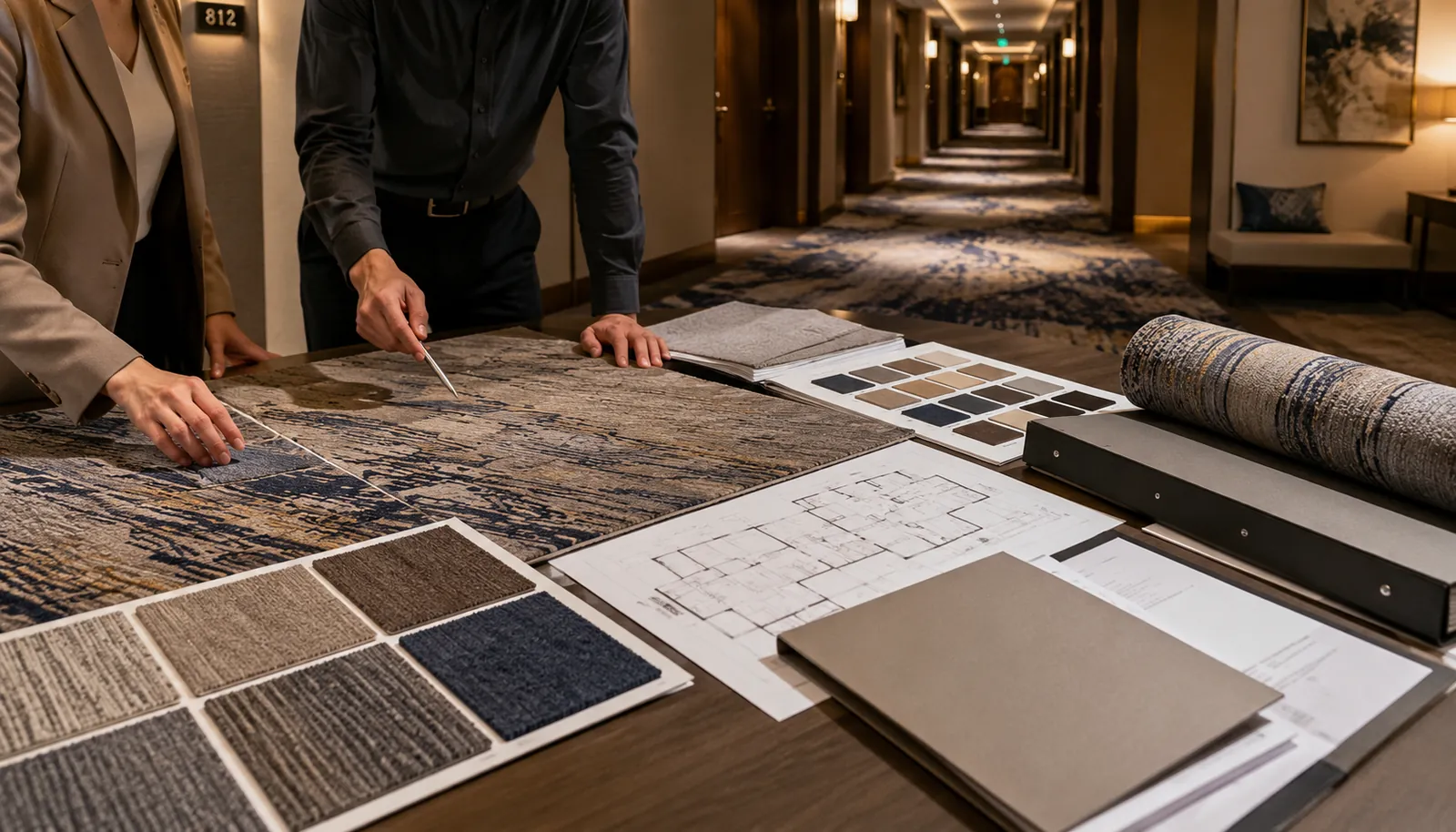
Pain Point Addressed
A hotel carpet can look convincing in a rendering and still fail the project when construction, color approval, roll planning, quality control, or delivery responsibilities remain unclear.
The Short Answer
A hotel carpet can look convincing in a rendering and still fail the project if the construction, color approval, quantity plan, production controls, or delivery sequence are incomplete. A useful hotel carpet supplier checklist therefore examines more than design. It tests whether the supplier can translate the interior concept into repeatable material, documented performance, workable rolls or tiles, and a shipment the installation team can actually use.
Before approving a supplier, confirm five conditions in writing. Price per square meter should be compared only after these conditions are aligned; otherwise, a lower quotation may simply exclude development, testing, inspection, packing, or project support included elsewhere.
- The product construction matches each hotel use zone.
- The approved color and pattern can be reproduced at project scale.
- Test documents apply to the construction being purchased.
- Quantity, roll planning, spare stock, inspection, packing, and delivery are defined.
- The supplier can trace the order back to approved samples and production records.
1. Has the Supplier Divided the Hotel Into Use Zones?
Guestrooms, corridors, lift lobbies, ballrooms, restaurants, stairs, entrance areas, and back-of-house spaces do not experience the same traffic or maintenance conditions. One construction can sometimes serve several zones, but that should be a deliberate decision rather than a default assumption.
A supplier should ask for an area schedule and explain whether each zone is best served by broadloom or carpet tiles, tufted or woven construction, different pile weights, coordinated patterns, or additional entrance and spare-stock planning.
- Guestrooms. Balance comfort, design, cleaning, room geometry, and installation efficiency.
- Corridors. Consider luggage traffic, soil visibility, acoustic comfort, pattern direction, and roll planning.
- Public areas. Review higher traffic, branded design, larger pattern scale, and local replacement needs.
- Ballrooms and meeting spaces. Coordinate furniture layouts, heavy use, visual scale, seams, and maintenance access.
2. Is the Proposed Construction Defined Clearly?
Names such as luxury carpet, heavy commercial carpet, or five-star quality are not specifications. The quotation should identify the fiber, construction method, pile weight, total thickness, backing, roll width or tile size, and intended traffic condition.
Ask which values are standard, which are selectable options, and which will be confirmed only after development. If a proposal uses an equivalent material, request the exact alternative before approving the price.
| Specification area | What to record | Why it matters |
|---|---|---|
| Surface construction | Tufted, printed, woven, cut pile, loop pile, or mixed construction | Affects appearance, performance, and price comparison |
| Fiber | Wool blend, nylon, polypropylene, polyester, or approved alternative | Affects hand feel, resilience, cleaning, coloration, and cost |
| Backing | Primary and secondary backing or tile backing system | Affects stability, installation method, and product compatibility |
| Dimensions | Roll width, tile size, pile height, total thickness | Affects planning, transitions, handling, and installation |
3. Do the Performance Documents Match the Supplied Product?
Request the documents relevant to the project country and intended use. Depending on the specification, these may cover fire behavior, static control, colorfastness, dimensional stability, acoustic performance, emissions, or other project requirements.
The important question is not whether the supplier has a folder full of certificates. It is whether the report describes the same fiber, pile, backing, thickness, and construction being quoted.
- Record the report issuer, report number, and date.
- Compare the tested product description with the quoted construction.
- Identify the applicable standard and reported result.
- Ask whether customization changes any tested component.
- Confirm whether the consultant or local authority requires a specific document format.
4. What Is the Sample Approval Sequence?
A small color swatch, printed strike-off, hand sample, and production sample answer different questions. The supplier should explain which approval stage is required before bulk production.
- Confirm the digital artwork and pattern repeat size.
- Provide initial color references or named standards.
- Produce the required strike-off, hand sample, or development sample.
- Record design and color corrections.
- Approve and identify the final physical sample.
- Retain matching production references for the buyer and supplier.
The hotel carpet supplier checklist should identify who has authority to approve color and whether approval is based on physical material, a screen image, or a named color standard. Screen-only approval is risky because displays, lighting, yarn, pile direction, and print penetration can alter the final appearance.
5. Can the Design Be Produced at the Correct Scale?
A pattern that works on a laptop may become too dense, too empty, or visually distorted in a four-meter corridor or a large ballroom. The design should be checked against actual hotel geometry before production.
- Confirm pattern repeat size and usable production width.
- Mark the direction of installation on plans.
- Review corridor centerlines, borders, doors, junctions, and changes in width.
- Define how adjacent widths will be matched and where seams are expected.
- Confirm artwork resolution and color-separation requirements.
- Plan transitions between guestrooms, corridors, lift lobbies, and public areas.
For directional designs, provide floor plans with room orientation so the designer, factory, and installer are working from the same geometry.
6. Are Sample, Trial, and Project Quantities Separated?
MOQ should be discussed in stages. A material swatch may be available before any commercial order. A printed strike-off or woven sample may require a development charge. A limited trial quantity may be possible after artwork approval, while full custom production may have a separate project minimum.
Ask whether the minimum applies per design, per colorway, per construction, per width, or to the complete order. Also confirm whether development charges can be credited against the final project order.
This part of the hotel carpet supplier checklist prevents a common misunderstanding: a low standard-product MOQ does not automatically apply to custom color, custom pattern, special backing, private labeling, or room-by-room packing.
| Order stage | Primary decision | Approval evidence |
|---|---|---|
| Material sample | Is the construction suitable? | Labeled swatch, sample, and data sheet |
| Design development | Can color and pattern be approved? | Artwork, strike-off, or hand sample |
| Trial quantity | Does the product work in a realistic area? | Mock-up or approved pilot installation |
| Project order | Can the full supply be released? | Signed specification, sample, quantity, QC, and delivery plan |
7. Has the Supplier Reviewed the Quantity and Roll Plan?
The purchase quantity should not be calculated from total floor area alone. Broadloom projects need a roll and cutting plan that considers room dimensions, pattern direction, repeats, seams, corridor widths, installation allowance, damaged material, and operational spare stock.
| Quantity element | What should be confirmed |
|---|---|
| Net installation area | Measured area by hotel zone, floor, and design |
| Pattern and cutting allowance | Additional material caused by geometry, direction, and repeat matching |
| Installation allowance | Material for cutting, fitting, site conditions, and agreed contingencies |
| Operational spare stock | Material retained for future repair or phased replacement |
| Total order quantity | Final quantity by design, color, width, and construction |
For carpet tiles, add carton-level allocation and replacement stock. For broadloom, request roll numbers, roll lengths, and the planned relationship between each roll and its installation zone.
8. Is the Production Schedule Based on Real Approval Dates?
Lead time should begin from a defined event. It may start after receipt of deposit, signed sample approval, final artwork, confirmed specifications, or all four. A fast production promise is not useful when the approval process has not been included.
Build the program backward from the required installation date and leave recovery time for sample revisions, inspection findings, weather disruption, or port delays.
- Required hotel installation or handover date.
- Local delivery, customs, and receiving allowance.
- International transport and export handling.
- Final inspection, packing, and loading.
- Bulk production and required material preparation.
- Sample correction, physical approval, and specification freeze.
9. What Will Be Checked During Production and Inspection?
A credible quality plan should describe what is checked, when it is checked, and how results are recorded. The exact checkpoints depend on the product, but project buyers need enough evidence to connect the approved sample with the finished shipment.
- Incoming yarn, backing, and color references.
- Color comparison against the signed physical sample.
- Pattern repeat, alignment, and visible design consistency.
- Pile surface, dimensions, thickness, backing, and obvious defects.
- Roll length, roll width, or carton quantity.
- Labels, packaging, pallet condition, and pre-shipment evidence.
The hotel carpet supplier checklist should also state how a nonconforming result is handled. Reinspection, sorting, correction, replacement, or written concession should be agreed before shipping, not improvised after the material arrives.
10. Is the Packaging Designed for the Installation Team?
Export-safe packaging protects the carpet, but project packaging should also help the receiving and installation teams identify where each item belongs. This is particularly important when several corridor designs, floors, or installation phases share one shipment.
- Project and purchase-order reference.
- Product, design, and color code.
- Roll or carton number and contained quantity.
- Production batch and inspection reference when required.
- Hotel zone, floor, room group, or installation phase.
- Handling, storage, and orientation information.
For phased projects, request separate packing lists or visible phase labels. Mixing several designs without clear identification creates avoidable handling and installation delay.
11. Has the Supplier Provided Installation and Site Requirements?
Carpet performance depends partly on site conditions and the installation system. Before shipment, confirm the recommended subfloor condition, acclimation, adhesive or underlay, seam treatment, stretching or direct-glue method, pattern alignment, and initial cleaning procedure.
The supplier does not replace the local installer or project consultant, but it should provide enough product-specific guidance for them to approve a compatible installation method.
- Check slab moisture and surface preparation.
- Confirm room temperature, humidity, storage, and acclimation requirements.
- Approve adhesive, underlay, seaming, and fitting methods.
- Coordinate pattern direction and seam placement with plans.
- Protect installed carpet from following trades and construction soil.
- Define cleaning and handover requirements before hotel opening.
12. Can the Supplier Support Reorders and Future Renovation?
Hotels replace stained or damaged areas, renovate floors in phases, and may repeat a design in another property. Ask how the supplier stores approved artwork, color references, construction specifications, batch records, labels, packing requirements, and inspection reports.
An exact color match years later cannot always be guaranteed, particularly after installed carpet has aged and been cleaned. The project should include appropriate spare material from the original batch and retain an identified approval sample for future reference.
Supplier Comparison Scorecard
Use a weighted scorecard after technical clarification. It will not replace professional judgment, but it makes important differences visible and prevents the purchasing team from selecting a supplier solely because one line of the quotation is lower.
| Evaluation category | Weight | Evidence to retain |
|---|---|---|
| Application and construction fit | 20% | Written recommendation and product data sheet |
| Sample and design control | 15% | Approved physical sample, artwork, and revision record |
| Relevant performance documents | 15% | Reports matched to the proposed construction |
| Quantity and roll planning | 10% | Area, allowance, spare stock, and roll plan |
| Production and quality control | 15% | Inspection plan and production evidence |
| Lead time and delivery planning | 10% | Milestone schedule and shipping basis |
| Packaging and installation support | 5% | Label samples, packing plan, and installation guidance |
| Commercial clarity and response quality | 10% | Complete quotation and written answers |
Warning Signs During Supplier Evaluation
One warning sign may be correctable. Several together indicate that the project is carrying more risk than the quoted price reveals.
- The quotation uses marketing descriptions without measurable construction data.
- The physical sample cannot be linked to a product or production reference.
- Test documents describe a different backing or fiber from the quoted material.
- The supplier promises every performance level without reviewing the project standard.
- Custom artwork is approved only through compressed chat images.
- Quantity does not include a cutting plan or spare-stock discussion.
- Lead time is promised before sample and specification approval.
- Inspection criteria and remedies are undefined.
- The supplier resists recording important commitments in the order documents.
Information to Send With the RFQ
The fastest way to use this hotel carpet supplier checklist is to prepare one structured project brief. Where a specification is not yet decided, describe the operational problem and ask the supplier to propose options with clear differences.
- Hotel location, property type, and opening or renovation schedule.
- Floor plans and area schedule by hotel zone.
- Product format required for each zone.
- Preferred construction, fiber, backing, width, and pile information.
- Design files, visual references, colors, repeat, and pattern direction.
- Traffic, maintenance, acoustic, and operational priorities.
- Applicable fire or other compliance requirements.
- Sample, strike-off, mock-up, and approval requirements.
- Estimated quantity, installation allowance, and spare-stock expectations.
- Destination, delivery terms, packaging, labels, and inspection requirements.
Request a Technical and Commercial Review
Use this hotel carpet supplier checklist before approving samples, signing the final specification, or comparing project quotations. The goal is not to create paperwork for its own sake. It is to make the design, product, factory, logistics, and installation plan agree before production begins.
Send Vishome your hotel area schedule, design references, required standards, target date, and delivery destination. The project team can recommend suitable broadloom or modular constructions, clarify sample and MOQ stages, and prepare a quotation around the actual hotel zones.
Continue Your Specification
Related Products
Browse the Full Range