
Gold Recovery Mat Procurement Guide
Gold Mining Sluice Carpet: Peru Roll and Container Guide
Specify gold mining sluice carpet by pile weight, roll size, flow and feed conditions, backing durability, samples, FOB terms and container loading.
Direct Buyer Answer
What This Application Guide Recommends
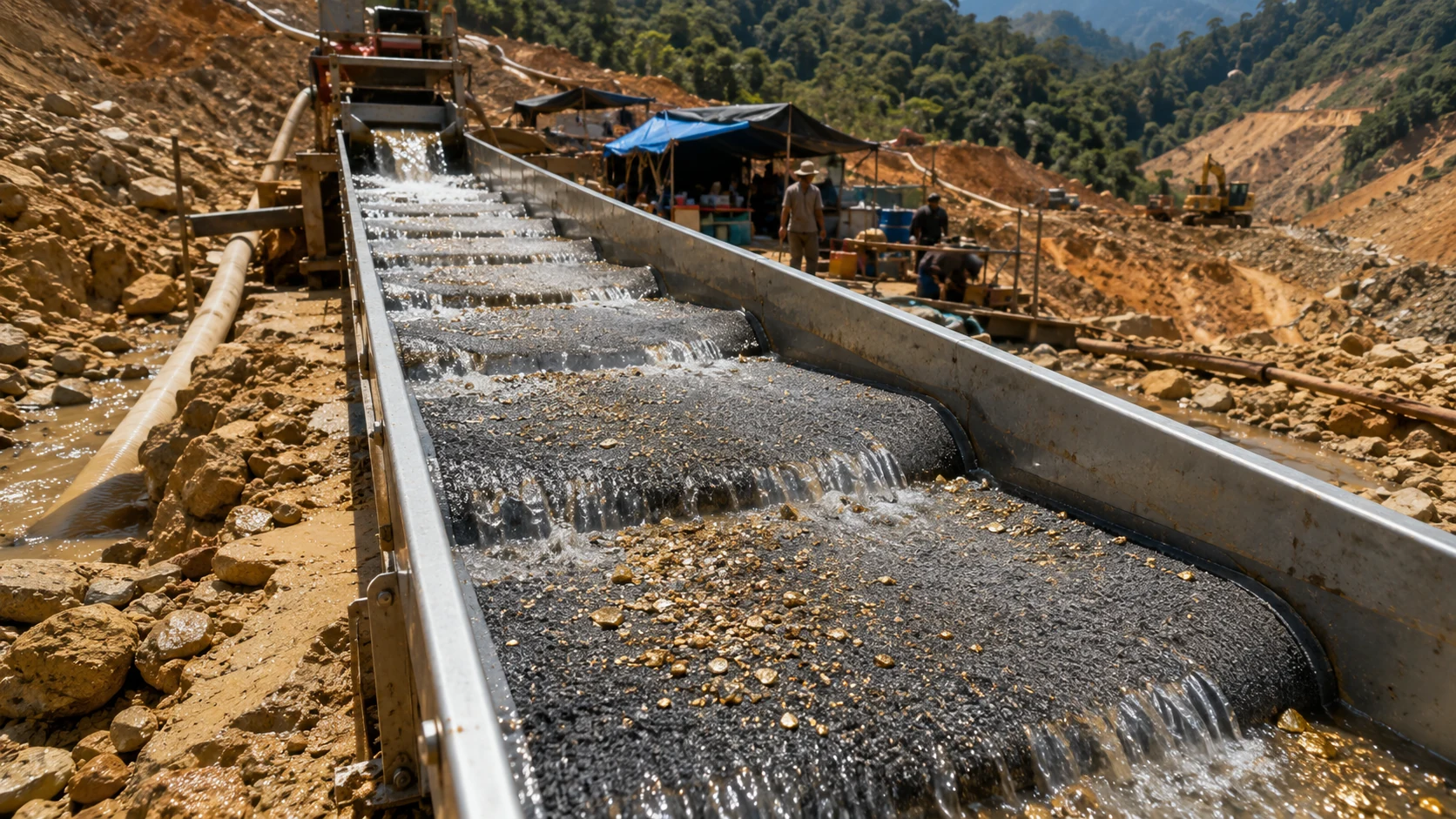
Gold-mining sluice carpet should be selected by particle size, feed rate, water velocity, riffle system, cleaning frequency, pile weight, backing strength, and roll dimensions rather than by thickness alone. Bulk buyers should test stocked weights first, match roll length to common sluice sizes, confirm wet handling and UV conditions, and calculate container loading from the exact rolled diameter.
Request a Project Specification- Application
- Alluvial gold sluices and bulk distributor programs
- Material Direction
- Polyester entrapment pile with reinforced backing
- Standard Roll Reference
- 2 m × 35 m; custom lengths available
- Primary Decision
- Recovery conditions, roll fit and container efficiency
Buyer Checks Before Approval
- Describe feed size, flow velocity and sluice construction
- Compare stocked pile weights with field samples
- Match roll width and length to equipment in the target market
- Confirm FOB specification, packing and 40HC loading calculation
Suitable For
- • Alluvial mining operations, sluice-box users and regional distributors
- • Bulk programs needing custom roll length and container planning
Limitations
- • Applications where field conditions have not been described or sampled
- • Claims of one universal pile weight for every recovery system
Evidence note: This is a field-specification and logistics guide, not a guaranteed recovery-rate claim. Gold capture depends on the complete sluice system, operating conditions, feed preparation and cleaning method as well as the mat.
Specification Table
| Parameter | Specification |
|---|---|
| Application | Alluvial gold sluice box · Highbanker · Trommel |
| Fibre | 100% Polyester |
| Weight Options | 1400 / 1700 / 1850 (custom) / 2100 g/m² |
| Thickness | 12–16 mm |
| Standard Roll | 2 m × 35 m (70 m² per roll) |
| Custom Roll | 2 m × 24 m and other custom lengths |
| Colour | Grey · Green · Black |
| Backing | Reinforced anti-tear |
| Sample Lead Time | Stocked weights immediate; custom weight approx. 16 days |
| Bulk Lead Time | Confirmed on order for 40HC quantities |
| Quotation Terms | FOB · CIF available |
What Sluice Carpet Does
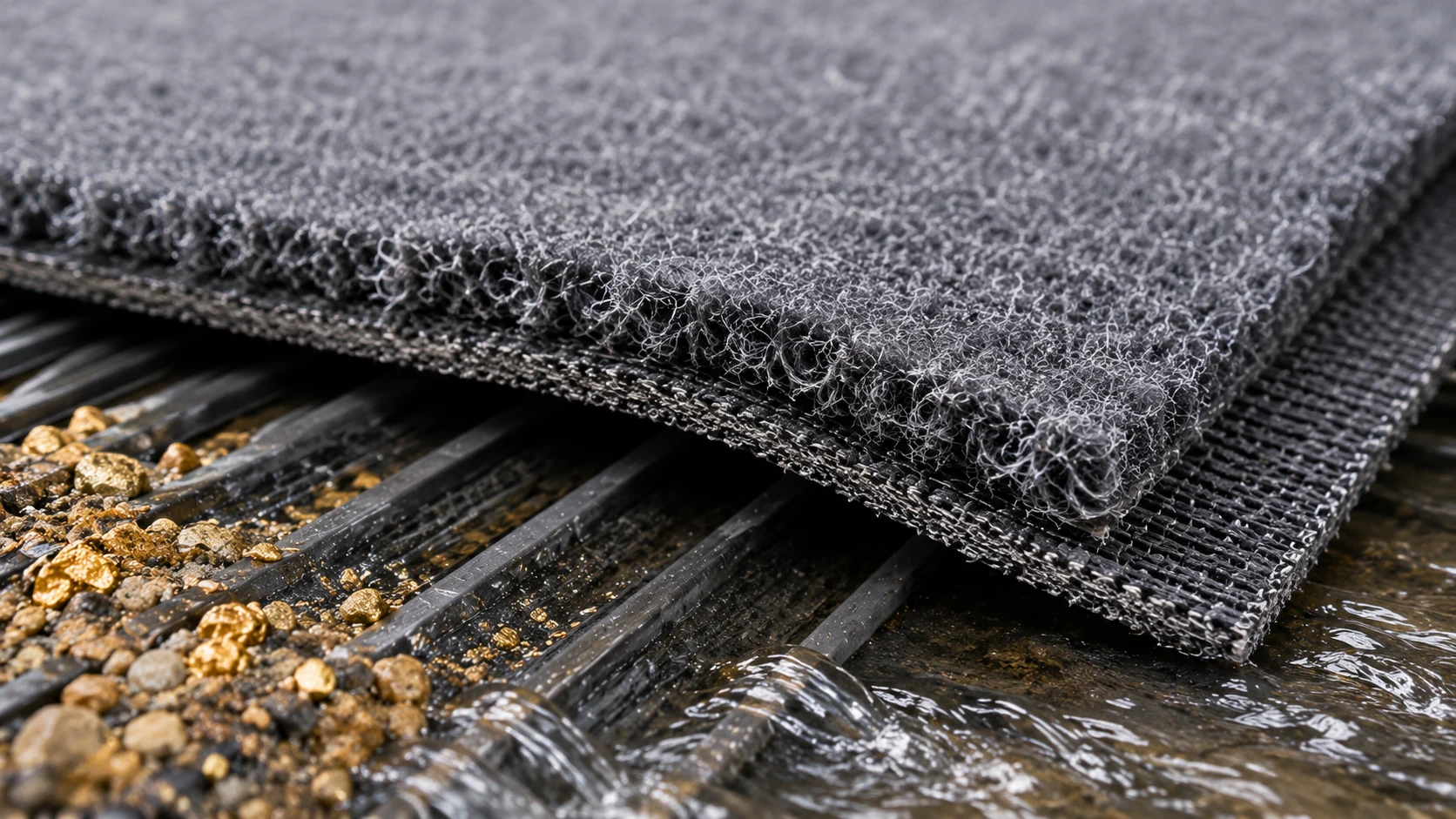
Sluice carpet performs a mechanical function rather than a decorative one. Laid beneath the riffle bars of a sluice box, highbanker, or trommel discharge, it creates a zone of reduced flow velocity at the floor of the run. Denser particles carried in the slurry drop out of suspension in this zone and are held in the fibre structure, while lighter sand and gravel continue downstream.
Because the mechanism depends on flow behaviour rather than surface appearance, the specification criteria have almost nothing in common with commercial carpet. Fibre weight, pile density, and resistance to continuous wet abrasion are the variables that matter. Colour, pattern, and stain resistance are irrelevant.
This distinction matters commercially as well. Buyers in this category are usually equipment distributors or mining supply wholesalers rather than end operators, and they purchase in container quantities against a defined regional demand.
Weight and Pile Structure
Fibre weight is the primary specification decision, and it is a trade-off rather than a case of heavier being better.
A carpet that is too light presents a shallow fibre layer. Flow passes close to the base, and finer particles are more easily lifted back into the stream and lost downstream. A carpet that is too heavy presents the opposite problem: the fibre bed restricts flow, coarse material packs into the pile, and cleaning cycles become more frequent, which means more downtime and more handling of a wet, heavy roll.
Four weights cover most alluvial applications:
- 1400 g/m² — lighter material loads, higher flow rates
- 1700 g/m² — general purpose, the most commonly stocked option
- 1850 g/m² — an intermediate specification produced to order
- 2100 g/m² — heavier feed, coarser material, lower flow velocity
Selection should follow the particle size distribution of the local material and the flow rate of the equipment in use, not a general assumption that a heavier mat recovers more.
Roll Dimensions and Sluice Box Fit
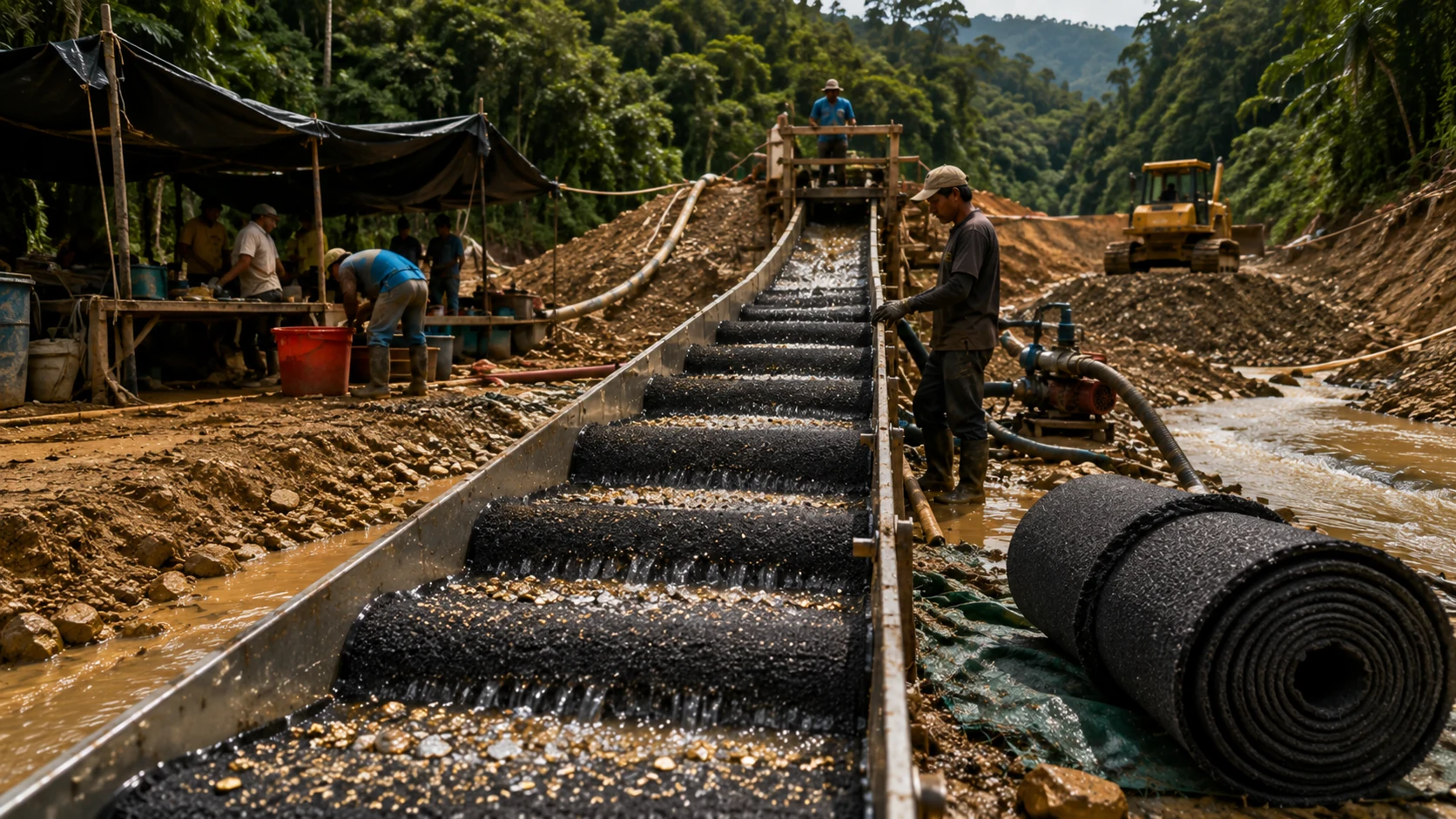
The standard production roll is 2 m wide by 35 m long, giving 70 m² per roll. This suits distributors supplying a range of equipment sizes, since operators cut to fit on site.
Custom roll lengths are also available — 2 m by 24 m is a frequently requested alternative. The reason to specify a custom length is waste reduction: when roll length is set as a multiple of the sluice run being supplied, off-cuts at the end of each roll are reduced or eliminated. For a distributor supplying a regional market where most operators run similar equipment, matching roll length to the dominant sluice dimension is a straightforward way to improve yield per container.
Thickness for these weights typically falls between 12 and 16 mm.
Material Durability in Field Conditions
Alluvial operations subject the material to continuous immersion, abrasive sediment, repeated lifting for cleaning, and sustained UV exposure in open-pit and riverbank settings.
100% polyester is specified for this application because it retains fibre structure under prolonged wet conditions and does not absorb water into the filament in a way that adds significant weight during handling. The backing carries the mechanical load: repeated lifting of a saturated mat full of trapped sediment places high stress on the fibre-to-backing bond, and a reinforced anti-tear backing is what determines whether the mat survives a full season of cleaning cycles rather than the fibre face itself.
Container Planning and FOB Quotation
Orders in this category are typically placed at 40HC container scale.
Loaded volume depends on rolled diameter, which in turn varies with weight and roll length, so the number of rolls per container is confirmed against the exact specification at quotation rather than assumed from a general figure. Where roll length is customised, this calculation should be run before the order is fixed, since a small change in roll length can change how efficiently rolls stack in the container.
FOB is the standard quotation basis. A clear FOB quotation should state fibre composition, weight in g/m², thickness, roll dimensions, square metres per roll, total square metres, and colour, so that the buyer can calculate landed cost against local freight and duty. Distributors reselling into a regional market generally need this level of detail to price their own offer, and requesting it explicitly at enquiry avoids a second round of clarification.
Sampling Before a Bulk Order
Samples in stocked weights — 1400, 1700, and 2100 g/m² — can be dispatched from existing inventory, with only courier costs applying.
A non-standard weight such as 1850 g/m² requires a dedicated production run to sample. This carries a lead time of approximately 16 days and a custom sampling charge of around USD 460, reflecting the machine setup involved.
For that reason the practical sequence for a first order is to evaluate stocked weights first. The fibre structure, backing, and general construction are consistent across the range, so a stocked sample answers most questions about build quality and field suitability. A custom weight can then be committed to with confidence, rather than paying setup costs to answer questions a stocked sample would have resolved.
Buyer Questions
Which sluice carpet weight gives the best gold recovery?
There is no universal best weight. Lighter or heavier pile changes flow interaction, holding capacity and cleaning frequency, so selection should be tested against particle size, water velocity and the full sluice system.
Why should a distributor customize gold carpet roll length?
Matching roll length to common local sluice sizes reduces off-cut waste and improves resale economics. The change also affects rolled diameter and container loading, so it should be calculated before the order is fixed.
Which carpet weight gives the best gold recovery rate?
There is no single best weight. A lighter mat suits finer material and higher flow rates; a heavier mat suits coarser feed and lower velocity. Too light and fine particles are more readily carried downstream; too heavy and the pile packs with coarse material, increasing cleaning frequency. Selection should follow the particle size and flow rate of the specific operation.
Can you produce custom roll lengths to match my sluice box?
Yes. The standard roll is 2 m × 35 m, and custom lengths such as 2 m × 24 m are produced to order. Matching roll length to the dominant equipment size in your market reduces off-cut waste per roll.
How many square metres fit in a 40HC container?
Loading depends on rolled diameter, which varies with weight and roll length. The figure is confirmed against your exact specification at quotation, particularly where custom roll lengths are involved.
Do you provide free samples before a bulk order?
Samples in stocked weights of 1400, 1700, and 2100 g/m² are provided free, with courier charges payable by the buyer. A non-standard weight requires a dedicated production run, with a lead time of approximately 16 days and a custom sampling charge of around USD 460.
Is the material resistant to continuous water immersion and UV exposure?
100% polyester is specified for this application because it holds fibre structure under prolonged immersion and outdoor exposure. The reinforced anti-tear backing carries the mechanical stress of repeated lifting when the mat is saturated and loaded with sediment.
Products for Similar Projects
Browse the Full Range
Related Product Categories
Related Application Guides
Healthcare Flooring Application Guide
Healthcare Carpet Tiles Planning - Singapore
Plan healthcare carpet tiles for suitable hospital interiors: cleanability, low static, acoustic comfort, fire documents and selective replacement.
Airport Flooring Application Guide
Airport Terminal Carpet Tiles Planning - Singapore
Plan airport terminal carpet tiles for passenger circulation: high traffic, wayfinding, overnight replacement, fire requirements and maintenance.
Exhibition Flooring Procurement Guide
Reusable Exhibition Carpet for Expo Booths - Johannesburg
Specify reusable exhibition carpet for expo booths: needle-punch pile, backing, fire rating, roll dimensions, installation and multi-show packing.
Need a Similar Project Solution?
Share your floor plan and timeline. We can build a solution package covering design, technical specification, and phased delivery strategy.
Request Similar Solution