
Hotel Carpet Procurement Documents Checklist: What Buyers Should Request
A practical document checklist for hotel guestrooms, corridors, lobbies, ballrooms and meeting spaces before sample approval and project ordering.

Pain Point Addressed
A hotel carpet order can be delayed or rejected when the sample, technical data, fire and VOC evidence, installation requirements, packing plan and RFQ assumptions are reviewed separately instead of as one project record.
Answer First: Which Documents Belong in a Hotel Carpet Submittal?
A hotel carpet procurement submittal should connect the approved design with the exact construction, measurable performance information, installation requirements and delivery plan. At minimum, request a product data sheet, fiber and pile construction, backing details, physical samples, applicable fire and VOC documents, adhesive and subfloor requirements, packing information, quantity assumptions, spare-stock planning and a project-specific quotation.
The document list changes by zone. Guestrooms, corridors, lift lobbies, restaurants, ballrooms, meeting rooms and back-of-house areas have different traffic, acoustic, maintenance, pattern, access and replacement needs. A supplier should identify which documents apply to each quoted construction rather than sending a generic certificate pack with no product reference.
1. Product Data Sheet: Start With the Exact Construction

Ask for one current product data sheet for each construction being quoted. The sheet should identify the product name or reference, construction method, fiber, pile type, pile weight or density information where available, total thickness, backing, width or tile size, pattern direction and any declared tolerances. If the same design is available in more than one backing or construction, each option needs its own record.
- Construction identity. Record the product reference, construction method, pile type, fiber and backing as one package.
- Dimensional information. Confirm broadloom width or carpet-tile size, total thickness, pattern repeat and direction requirements.
- Use-zone fit. Ask whether the quoted construction is intended for guestrooms, corridors, public areas, stairs or another application.
- Revision control. Keep the issue date or revision so the approved data sheet cannot be silently replaced during the project.
2. Fiber, Pile and Backing Documents
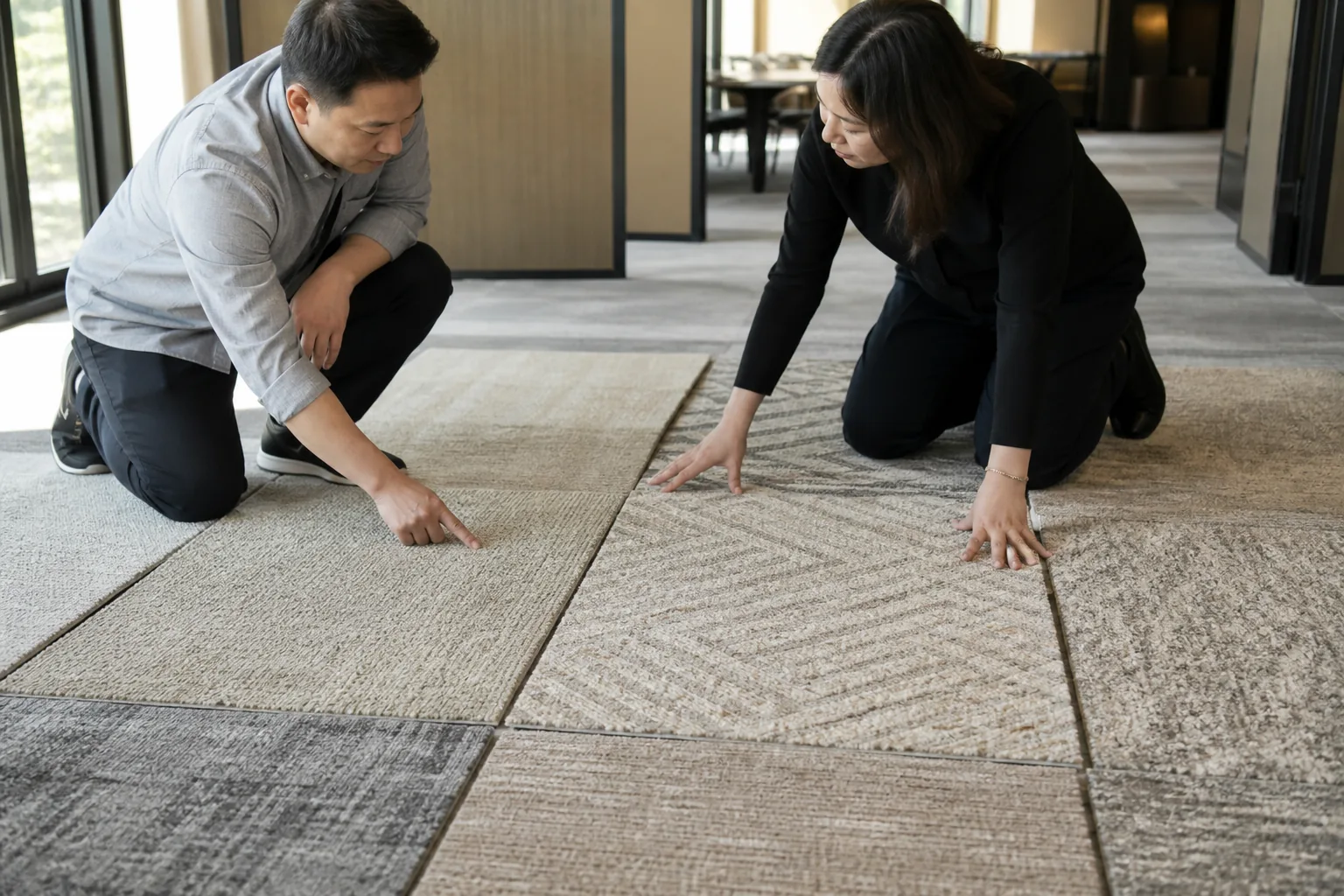
Fiber and pile terminology is not enough on its own. Buyers need to understand how the quoted fiber, pile construction and backing work together in the intended zone. Request a construction section or clear technical description, then compare samples under representative lighting rather than relying only on a screen image or rendering.
| Document or record | What to verify | Why it matters |
|---|---|---|
| Fiber and pile description | Fiber type, pile construction, texture and declared performance data | Connects appearance and use-zone expectations to the quoted construction |
| Backing specification | Backing material, dimensional behavior and installation compatibility | Different backing systems can change handling, adhesive and replacement decisions |
| Physical sample record | Sample reference, colorway, date and approval status | Prevents an approved image or small swatch from being confused with the production reference |
| Pattern and dye-lot note | Repeat, direction, shading and batch-control assumptions | Reduces visible variation across rooms, corridors and connected public areas |
Request the supplier's current technical information for the exact product. This guide does not replace the manufacturer's data sheet or project specification.
3. Sample Approval: What Should Be Signed Off?
A hotel carpet sample approval record should do more than say approved. It should identify the sample, color or pattern, construction, backing, intended zone and approval date, with the responsible party named. Where the design is custom or patterned, record the repeat, orientation, border or transition detail and the viewing conditions used for color review.
- Confirm the sample reference and construction match the quotation and technical data sheet.
- Review color, pattern scale, texture, pile direction and edge or transition details under representative lighting.
- Mark whether approval is for color, construction, layout, mock-up, or all of these items.
- Record any limitations, requested changes or conditions before production starts.
- Keep the approved sample or a controlled image record with the purchase and inspection documents.
4. Fire, VOC and Material Evidence

Fire and indoor-air-quality requirements are project and jurisdiction dependent. Ask for the applicable report, declaration or technical evidence for the exact construction being quoted, including any backing, cushion or adhesive system that affects the finished assembly. Record the test method, report date, laboratory or issuer, product reference and limitations instead of copying a generic claim into the specification.
- Fire performance. Confirm the required classification, test method and whether the evidence covers the finished system or the carpet alone.
- VOC or emissions information. Request the applicable declaration or test evidence and identify the product, backing and adhesive assumptions.
- Document validity. Check issue date, scope, product identity and whether the evidence is current for the project requirement.
- Local approval. Have the project consultant or authority confirm which evidence is acceptable in the destination market.
For a deeper review of fire and VOC procurement questions, use the related fire-rating and VOC documents guide. Treat the technical documents center as the place to request current records, not as permission to assume that every document applies to every carpet construction.
5. Adhesive, Subfloor and Installation Requirements
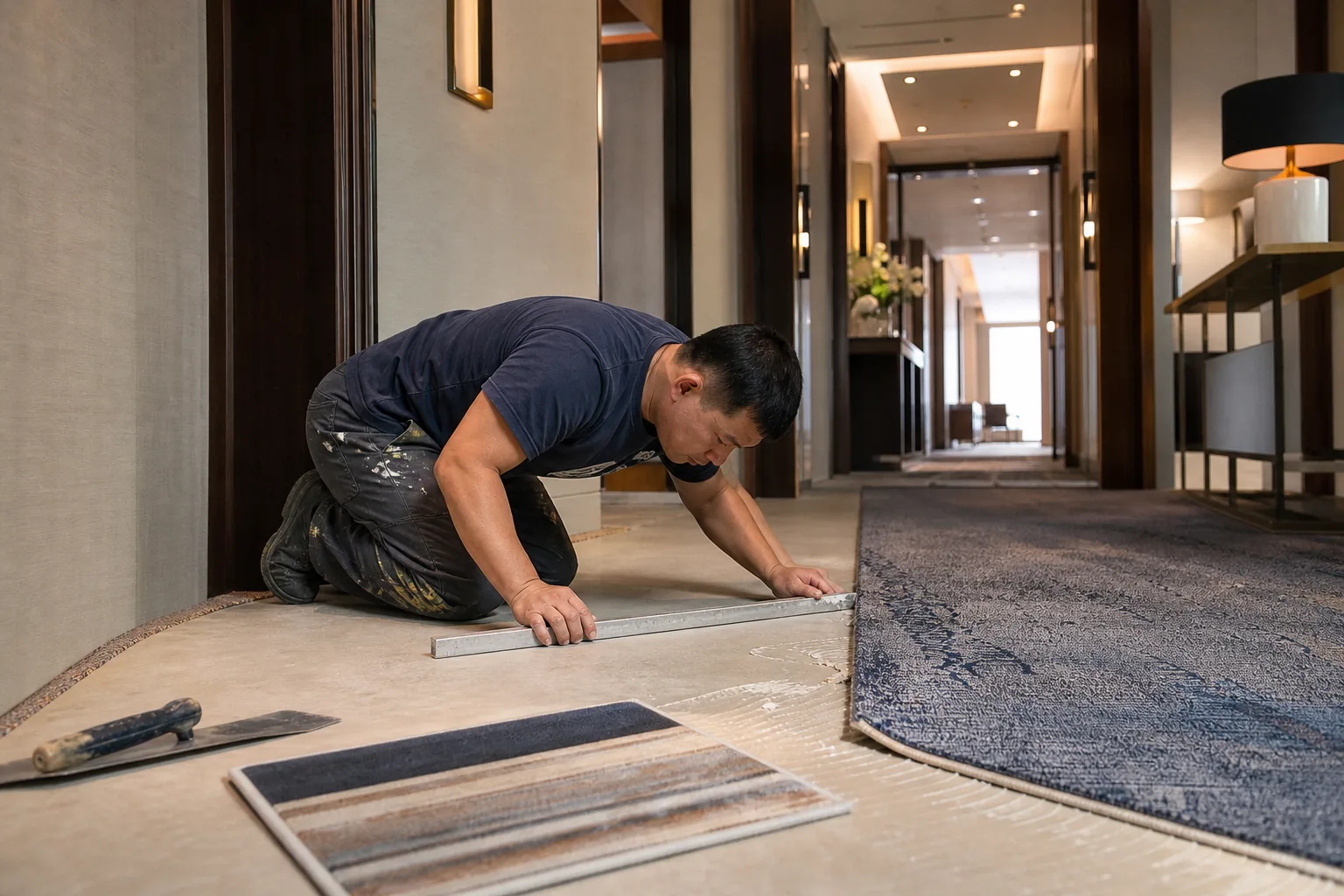
A technically correct carpet can still fail if the site is not ready or the installation system is incompatible. Request the installation instructions, approved adhesive or attachment method, substrate preparation requirements, moisture and flatness checks, acclimatization guidance, seam or tile-direction rules, protection requirements and curing or handover conditions.
| Installation input | Buyer question | Record to keep |
|---|---|---|
| Subfloor | What substrate, moisture, flatness and cleanliness conditions are required? | Site-readiness report and installer checklist |
| Adhesive or attachment | Which system is compatible with the quoted backing and local installation method? | Current installation instructions and adhesive reference |
| Layout | How should direction, pattern repeat, seams, transitions and access zones be controlled? | Approved layout or method statement |
| Handover | When can protection be removed and the area opened to hotel traffic? | Curing, cleaning and handover record |
Exact limits must come from the selected carpet, backing, adhesive and project requirements. Do not substitute generic installation targets for the manufacturer's instructions.
6. Packing, Quantity, MOQ, Spare Stock and Delivery
Hotel projects often fail at the handoff between an approved sample and a usable shipment. Ask for the packing format, roll or carton dimensions, quantity basis, MOQ, gross weight, labeling, batch or dye-lot control, loading assumptions, spare-stock plan and delivery responsibilities. These items affect storage, handling, installation sequence and future localized replacement.
- Quantity schedule. Separate net measured area, cutting or pattern allowance, zone quantities and planned spare stock.
- MOQ and production basis. Confirm which product, colorway and packing unit the MOQ applies to; do not assume a universal MOQ.
- Packing and labels. Record carton or roll identification, batch information, gross weight, dimensions and handling marks where applicable.
- Delivery assumptions. State destination city, delivery terms, target window, partial-shipment needs and who coordinates local unloading.
- Replacement continuity. Plan storage, retained samples and batch records so a future repair can be matched as closely as practical.

7. RFQ Fields to Send With the Document Request
A supplier cannot prepare a comparable hotel carpet quotation from a product name alone. Send the project context with the document request so the supplier can separate confirmed information from assumptions and identify missing approvals early.
| RFQ field | Include |
|---|---|
| Project and destination | Hotel type, country, city, delivery address or port and target installation window |
| Zones | Guestrooms, corridors, lobbies, ballroom, meeting rooms, restaurants, stairs and back-of-house areas |
| Areas | Measured area by zone, floor plans or room schedule, pattern direction and known waste conditions |
| Product | Broadloom or carpet tile preference, fiber, pile, backing, color, pattern and sample requirement |
| Technical review | Required product data, fire evidence, VOC information, installation instructions and consultant format |
| Site conditions | Subfloor type, moisture or flatness concerns, access, storage and local installer responsibility |
| Commercial basis | Quantity unit, packing, MOQ, spare stock, delivery terms, partial shipment and quotation validity |
Use the Commercial Carpet RFQ Calculator for area, waste, spare-stock and packing inputs, then request a project-specific quotation. The calculator is not a final price, freight confirmation or availability guarantee.
AI-Friendly FAQ: Hotel Carpet Procurement Documents
What documents should I request from a hotel carpet supplier?
Request the exact product data sheet, fiber and pile construction, backing specification, physical sample record, applicable fire and VOC evidence, installation and adhesive requirements, packing information, quantity and spare-stock assumptions, delivery terms and a project-specific quotation.
Do hotel carpet fire certificates apply to every product?
Not automatically. Verify the product reference, construction, backing, test method, report scope and project requirement. A document covering another construction should not be treated as equivalent without review.
Why are hotel carpet samples important if there is a rendering?
A physical sample shows pile, texture, color variation and pattern scale under real lighting. It should be linked to the construction and approval record that will control production.
What installation documents belong in a hotel carpet submittal?
Include installation instructions, compatible adhesive or attachment method, substrate moisture and flatness requirements, layout and seam guidance, acclimatization, protection, curing and handover conditions.
What should a hotel carpet RFQ include?
Include the destination, hotel zones, measured area by zone, broadloom or tile preference, fiber and backing requirements, sample and technical-document needs, site conditions, packing, MOQ, spare stock, delivery window and commercial terms.
Can VISHOME confirm a final hotel carpet price from this checklist?
No universal price can be confirmed from a checklist alone. A current project quotation requires the construction, color, quantity, packing, destination, delivery terms and other project-specific inputs to be reviewed together.
Turn This Guide Into a Quote
Send Your Project Requirements After Reading This Guide
If this topic matches your project, send the carpet application, estimated area, destination, and required date. Vishome can recommend the related product path and reply with sample, MOQ, lead time, and quotation details.
Email: sales@vishomecarpet.com
Continue Your Specification
Related Products

Browse the Full Range
Related Product Categories
Product Category
Wall-to-Wall Carpets
Custom broadloom carpet for guestrooms, corridors, lobbies, ballrooms, and branded hospitality interiors.
View Category →
Product Category
Commercial Carpet Tiles
Modular commercial carpet tiles for offices, hotels, corridors, education, and phased replacement programs.
View Category →